
Perseverance Atlas – The Polar Regions, Part I: Ice, Crystal, and Silence
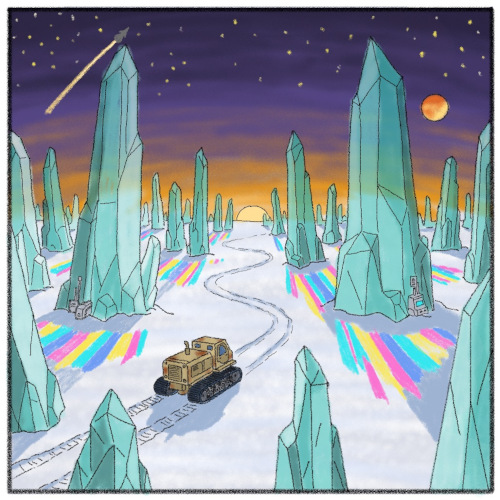
"Past the ice roads, the land don't care if you live or die. And most times, it figures you won't." – Elias Morro, ice runner
Beyond the mountain passes, beyond the last cairn markers and the last radio relay, the world turns white.
The Polar Regions are Perseverance's endgame: a frozen wilderness covering both poles in ancient ice, wind-sculpted plateaus, and silence so deep it presses against your skull. No one comes here by accident. It attracts prospectors chasing mineral deposits locked in permafrost, scientists studying phenomena the Commonwealth would rather ignore, exiles who ran out of warmer places to hide, and the Icebound Covenant, who found something in the ice worth building a civilization around.
This is the first of two posts mapping the Frozen Expanse. Today we chart its biomes and the strange landmarks hidden beneath the frost. In Part II, we'll visit the settlements that cling to survival here and the dangers that make every journey a calculated risk.
A Land of Extremes
Let's set the baseline: temperatures drop to –70°C in winter. Blizzards strike without warning and last for days. The atmosphere thins further at polar altitudes. Ice roads shift seasonally, cracking open routes that existed for decades and sealing others shut. Navigation equipment behaves erratically near the poles, where magnetic anomalies and ancient impact craters create dead zones in every frequency.
The Frozen Expanse is the least populated and least understood region on the planet. It is also, if the rumors are true, the one with the most to hide.
Major Biomes
The White Wastes
The defining feature of both poles: flat, featureless expanses of compacted snow and glacial ice stretching to the horizon in every direction. In winter, the sun barely rises. In summer, it barely sets, painting the ice in shades of amber and rose for weeks at a time, beautiful and disorienting in equal measure.
Nothing grows here, and the wind is constant. Experienced ice runners navigate by sound, vibration, and the feel of the surface beneath their treads — instruments are unreliable, and memory is worse.
The Wastes are crossed by ice roads, semi-permanent routes maintained by collective effort and marked with sonic beacons, reflective poles, and cairns. When roads crack or shift, communities can be cut off for weeks. The roads are Perseverance's most fragile infrastructure: invisible from orbit, essential on the ground, and maintained by no one in particular.
"The ice don't forgive mistakes. One crack, one slip – that's all it takes." – Mira Kell, ice road veteran
The Crystal Fields
In the transition zone between the mountain foothills and the deep polar interior, the ice takes strange forms. Mineral-laden water has frozen into towering, translucent spires — some reaching ten meters or more. They shift and grow with the seasons, cracking and reforming as temperatures fluctuate.
The spires refract what little sunlight reaches them, casting prismatic patterns across the snow. At night, they groan with a low, harmonic creaking that carries for kilometers. Locals say the fields sing. Scientists say it's thermal contraction. Neither explanation accounts for the fact that the patterns of light sometimes repeat in sequences too regular to be random.
Prospectors value the Crystal Fields for the rare mineral deposits locked in the ice: lithium concentrations, phosphorescent silicates, and occasionally fragments of crystalline fossil that match those found in the Shattered Mountains. Extraction is difficult — the spires resist cutting, and heavy equipment tends to sink into the unstable substrate beneath them.
The Howling Plateau
Where the polar terrain rises above the surrounding ice sheets, exposed rock forms high plateaus battered by winds that never stop. The wind accelerates through natural corridors, reaching speeds that knock a person flat and strip exposed skin raw. Ice crystals in the gale act like sandpaper.
Despite the hostility, the Plateau is strategically important. It offers the only elevated ground in the polar regions, making it valuable for relay stations, observation posts, and (for the Icebound Covenant) defensive positions that are nearly impossible to approach unseen.
The Buried Caldera
Beneath the polar ice caps, geothermal activity persists. In several locations, volcanic heat has carved out subglacial chambers — pockets of warmth where temperatures hover near freezing rather than far below it. The largest is the Buried Caldera, a collapsed volcanic vent beneath the northern ice sheet that supports a microclimate unlike anything else on the planet.
Inside the Caldera, meltwater pools collect in rocky basins. Bioluminescent microorganisms coat the walls, casting a faint blue-green glow. The air is humid and breathable without filters — a shock to anyone who's spent weeks in the dry cold above. Some settlers have reported seeing small, translucent creatures moving through the pools, though no specimens have been recovered.
The Caldera is known to a handful of ice runners, a few Commonwealth scientists who were quietly reassigned after filing their reports, and the Icebound Covenant. Whether the Covenant controls access or simply monitors it is unclear. What's clear is that people who enter without permission don't come back to report on it.
"There's heat down there. Life, even. And something else — something that's been warm a lot longer than we've been cold." – Anonymous ice runner, northern polar route
Landmarks
The Frozen Expanse holds places that resist explanation. These aren't destinations so much as warnings — sites where the ice remembers something older than settlement, and where the planet's deeper mysteries press closest to the surface.
Glacier's End
Abandoned Commonwealth research station
The largest surviving Commonwealth installation in the polar regions, Glacier's End was built during an early wave of exploration and officially decommissioned fifteen years ago. Prefabricated modules on a rocky shelf overlooking the northern ice sheet, partially buried in drift ice. Officially a climate monitoring station. Unofficially, its research logs reference subsurface energy readings, anomalous ice core samples, and deep-bore surveys that were abruptly terminated.
The station was evacuated on short notice: equipment was left behind, and power systems were never fully shut down. The deep-bore shaft (sealed with reinforced plating and Commonwealth lockdown codes) has never been reopened.
At least, not officially.
"The Commonwealth didn't abandon Glacier's End because the funding ran out. They abandoned it because something answered the drill." – Dr. Elias Morrow, xenoarchaeologist
The Rift Mouth
Polar impact crater with anomalous readings
A massive impact crater (estimated at sixty kilometers across) in the northern polar region, partially beneath the ice sheet. Only its southern rim is exposed: a curved wall of shattered rock rising from the frozen plain like the jawbone of something enormous.
Instruments brought into the crater record energy signatures that shouldn't exist: low-frequency pulses with mathematical regularity, temperature differentials that reverse without cause, electromagnetic readings that cycle in patterns matching no known geological process. The xenoarchaeologists believe the Rift Mouth is the strongest evidence for pre-human presence on Perseverance. The Commonwealth has classified all data from the site, and Orion Geotech has applied for exclusive mineral rights — though neither seems interested in actually mining.
"Sixty kilometers across and they want us to believe it's just a hole in the ground. Holes don't hum." – Cipher Lyris, Black Veil Society
The Pilgrim's Spine
Ancient cairn trail of unknown origin
A line of stone cairns stretches across the northern Wastes for over two hundred kilometers, running roughly north-south from the foothills to the edge of the Rift Mouth. The cairns are old — far older than the Commonwealth presence, possibly older than the settlement of Perseverance itself. They're built from local stone, stacked in a style that doesn't match any known settler tradition.
Some bear carved symbols that match markings found in the Crystal Vaults beneath the Shattered Mountains. Others have small cavities carved into their tops that collect meltwater, or that might have held something else, once.
Ice runners use the Pilgrim's Spine as a navigation aid, though most prefer not to camp near the cairns. Animals avoid them, and the wind behaves strangely around them, dying to nothing within a few meters before resuming at full force beyond. Nobody knows who built them, and nobody has tried to dismantle one.
The Mirror Lake
Subglacial lake visible through translucent ice
Beneath a section of unusually clear polar ice lies a body of liquid water — a subglacial lake kept from freezing by geothermal heat. The ice above it is clear enough that the lake is visible from the surface: a dark, still expanse under the frost, reflecting distorted light back up through the ice like a mirror buried in glass.
The Mirror Lake has never been drilled into. The Commonwealth planned an expedition but cancelled it, the Icebound Covenant patrols its perimeter, and ice runners give it a wide berth — not because of the Covenant, but because vehicles that cross the thin ice above the lake report their instruments behaving as though they're receiving signals from below.
Whether anything lives in the Mirror Lake is unknown. Whether anything is transmitting from it is a question nobody with authority wants to answer.
What's Next
In Part II, we'll explore the settlements that somehow survive in this frozen wilderness — from the scientific outpost at Frostwatch to the hidden geothermal refuge of Icehaven — and meet the dangers that make the Polar Regions Perseverance's most unforgiving frontier. Arctic Leviathans, polar blizzards, the ice itself, and the persistent feeling that something beneath the surface is paying attention.
The ice waits. It always waits.