
The Mountain Ranges – Part II: Settlements and Survival
The communities that cling to the heights, the dangers that define them, and the stories written in stone and silence
"Nobody builds a town in the mountains because it's convenient. They build it because they're hiding, mining, or too stubborn to come down." – Brennan Goss, Supply Runner
The mountains of Perseverance don't just resist settlement – they reshape anyone stubborn enough to try. In Part I, we mapped the biomes and landmarks that define the heights: iron-veined ridgelines, shattered calderas, wind-blasted passes, and caverns that hum with something older than memory. Now we step inside the lives built on those slopes.
These are communities forged by altitude, isolation, and the knowledge that the ground beneath their feet has the final word. Mining towns that outlived their corporate sponsors. Separatist strongholds hidden in collapsed calderas. Trading posts where neutrality is enforced by stacked stones and unspoken consequence. And a research camp chasing answers the Commonwealth says don't exist.
This is where the stories of the heights get personal – where the names on the map start meaning something, and the mountain starts keeping score.
Settlements of the Heights
The mountain settlements are small, isolated, and defined by what drove their founders uphill. Some are mining camps that outlived their corporate sponsors. Others are hideouts that grew into communities. A few exist because the mountains offered something the lowlands couldn't: silence, secrecy, or access to what lies beneath.
Ironreach
Mining town on the Blackfang slopes
Perched on a shelf of dark stone halfway up the Blackfang western face, Ironreach is the mountain ranges' oldest surviving settlement – and it looks every year of it. Founded during the second mineral rush as a staging camp for deep-vein extraction, it outlasted the companies that built it through sheer refusal to die.
Three hundred souls live here, give or take – miners, mechanics, traders, and the families stubborn enough to raise children at altitude. The town is built vertically: living quarters stacked in tiers along the cliff face, connected by rope bridges, cable lifts, and iron staircases that groan in the wind. The mine entrance sits at the bottom, gaping like an open mouth. Everything flows downhill – ore, water, waste, and bad news.
Ironreach produces high-grade ferromagnetic ore and trace crystalline deposits, traded down the Silver Creek route to Virey's Claim. It's enough to keep the town alive, but not enough to make it comfortable. Equipment breaks faster than it can be replaced. The air is thin enough to make newcomers dizzy for weeks. And the mine, everyone agrees, goes deeper than it should.
"We dig because the mountain lets us. Some days I wonder what happens when it stops." – Foreman Hetta Brask, Ironreach Mine Council
Knifepoint
Separatist stronghold in the Shattered Mountains
Knifepoint doesn't appear on any Commonwealth map – which is exactly the point. Hidden in a collapsed caldera in the central Shattered Mountains, accessible only through a series of narrow passes and one concealed tunnel, Knifepoint is the operational heart of Captain Rourke Kane's separatist network.
The settlement is part fortress, part refugee camp, part arms depot. Kane's militia maintains a disciplined presence – patrols, training schedules, supply discipline – but the civilians who've gathered around them are a messier story. Deserters, exiles, political dissidents, and people who simply couldn't survive under Commonwealth rule anymore. They grow what they can in the caldera's sheltered microclimate, supplement with raided supply convoys, and wait for the revolution Kane keeps promising.
The Commonwealth knows Knifepoint exists. They don't know exactly where. Company 4 of the Rangers – the Shattered Mountains unit, feared for brutality and rumored corporate payoffs – has been tasked with finding it. So far, the mountains have kept the secret. But the passes get narrower every year, and Kane's raids are getting bolder.
"They say the Commonwealth is our master. I say it's high time we remind them who really rules this land." – Captain Rourke Kane, Separatist Leader
Highcairn
Trading post at the roof of the world
At the junction of the three most-traveled Blackfang passes sits Highcairn – less a town than a permanent negotiation. Built around a Commonwealth-era weather station that nobody bothered to dismantle, Highcairn serves as the northern mountains' only neutral trading post. Everyone passes through. Nobody stays long.
The population fluctuates between forty and two hundred depending on the season. In summer, when the passes are navigable, Highcairn buzzes with traders, couriers, smugglers, and the occasional Commonwealth patrol pretending not to notice the contraband. In winter, it contracts to a skeleton crew of permanent residents who maintain the weather station, the fuel depot, and the tavern – because even at the roof of the world, someone needs to pour drinks.
Highcairn's unwritten law is simple: no violence inside the cairn ring. The ring – a circle of stacked stones surrounding the settlement, maintained by every traveler who passes through – marks the boundary. Inside, disputes are settled with words, trades, or arbitration by whoever's oldest. Outside, the mountains settle disputes their own way.
"Highcairn isn't a town. It's a handshake with a roof. You do your business, you add a stone to the ring, and you move on." – Jemma Cord, Pass Trader
Cinderwell
Geothermal settlement on borrowed time
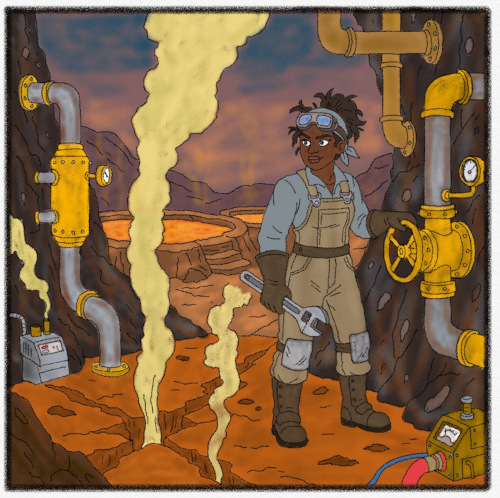
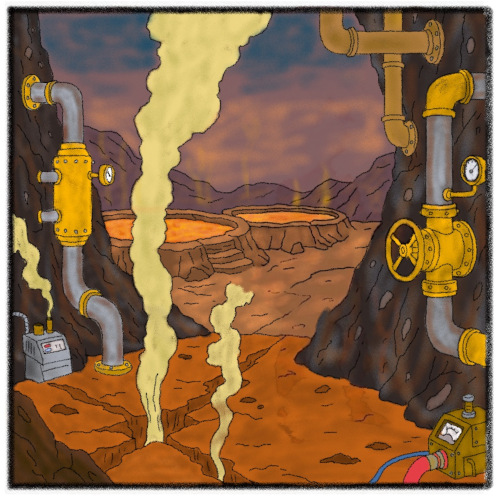
Deep in the Ash Vents of the Shattered Mountains, where the ground steams and the air tastes like sulfur, Cinderwell has carved out an existence powered entirely by the heat beneath its feet. The settlement sits in a natural basin surrounded by fumaroles and hot springs, its buildings constructed from volcanic stone and insulated with heat-resistant ceramics scavenged from abandoned industrial sites.
Cinderwell exports two things: geothermal power cells and thermal-treated alloys hardened in the natural forges of the Vents. Both are valuable enough to keep the supply lines open despite the murderous terrain. The town's engineers – a mix of former corporate techs, self-taught mechanics, and one brilliant lunatic named Sera Voss – have tapped the volcanic system with a network of pipes, condensers, and heat exchangers that would make a Commonwealth engineer weep with envy or terror.
The problem is the ground itself. Cinderwell has relocated twice in its thirty-year history – each time because the geology shifted and what was stable became lethal. The current site has been good for eight years. The engineers say it's good for twenty more. The ground, as always, hasn't been consulted.
"We live on top of a volcano because it's warm and the rent is free. When it evicts us, we'll move. Until then – pass the wrench." – Sera Voss, Thermal Engineer
Morrow's Camp
Xenoarchaeological research site
In a wind-sheltered hollow on the inner slope of the Shattered Mountains, a cluster of insulated tents, equipment sheds, and one reinforced cavern entrance marks Morrow's Camp – the unofficial headquarters of Perseverance's xenoarchaeological community. It's not on any map. The path changes every season. And the people who work here would prefer you didn't mention it.
Dr. Elias Morrow runs the camp with the quiet intensity of a man who's seen something he can't explain and won't stop until he can. His team – a rotating cast of field researchers, amateur enthusiasts, and sympathetic academics providing covert support – works in shifts, mapping the cavern systems, cataloguing crystal formations, and trying to decode patterns that might be language, might be mathematics, or might be something else entirely.
The Commonwealth has raided the camp twice. Both times, Morrow relocated within a week. Both times, the most sensitive data had already been moved – hidden in caches across the mountains that only Morrow's inner circle can access. Orion Geotech has offered funding three times. Morrow refused each time, convinced their interest is extraction, not understanding.
"They call us crackpots. That's fine. The crystals don't care what anyone calls us. They just keep humming." – Dr. Elias Morrow, Lead Researcher
Frontier Dangers in the Heights
"The mountains don't kill you fast. They kill you thoroughly." – Brennan Goss, Supply Runner
The Mountain Ranges compress Perseverance's dangers into vertical space. Every hazard the planet offers – predators, weather, unstable ground, ancient technology – exists here, but stacked on top of itself. The margin for error narrows with every meter of altitude gained.
Storm Wraith Attacks
The mountains are Storm Wraith territory. These massive predatory birds – wingspans exceeding five meters – ride high-altitude thermals and dive at speeds that outpace most skiffs. They're territorial, intelligent, and aggressive. Nesting colonies like the Watcher's Roost are permanent no-fly zones, but individual wraiths range across the entire mountain system, and they don't distinguish between prey and trespassers.
Their shrill cry is often the only warning – and by the time you hear it, the dive is already underway. Experienced mountain travelers learn to read the sky the way plainsmen read the grass: the absence of smaller birds, a sudden stillness in the wind, a shadow that doesn't match any cloud.
"A storm wraith don't give warning. One second you're talking, the next, the man next to you is just… gone." – Lena Holt, Mountain Guide
Altitude and Thin Air
Perseverance's atmosphere is already thin at sea level – 18% oxygen compared to Earth standard. In the mountains, it gets worse. Above two thousand meters, unacclimatized travelers experience dizziness, impaired judgment, and exhaustion. Above three thousand, without supplemental oxygen or genetic adaptation, the body begins to shut down.
Mountain-bred settlers – the Danner kids and their kind – breathe this air like it's normal. Lowlanders don't. The difference has killed more outsiders than any predator or rockslide. The mountain doesn't care about your fitness, your gear, or your schedule. It cares about your lungs.
Rockslides and Seismic Instability
The Shattered Mountains earned their name. Seismic events are frequent – small tremors that dislodge boulders, shift passes, and occasionally open new cavern entrances while sealing old ones. The Blackfangs are more stable but compensate with magnetic instability that interferes with equipment and navigation.
Rockslides are the most common cause of death in the ranges. They happen without warning, triggered by temperature shifts, seismic tremors, or the simple accumulated weight of frost on loose stone. Experienced mountain travelers know the signs – fresh scree, cracked overhangs, the sound of settling rock that sounds almost like breathing – but knowing the signs and reacting in time are different skills.
Shatter Zones
Regions of the mountain surface are riddled with collapsed lava tubes and ancient cavern systems that appear solid but aren't. A Shatter Zone can support a person's weight for years, then collapse without warning under a loaded skiff, dropping vehicle and crew into a chasm that may be ten meters deep or a hundred.
The Ash Vents are particularly dangerous – geothermal activity weakens the crust from below while surface erosion thins it from above. Cinderwell's residents probe the ground ahead with sonic rods before every expansion. They've learned the hard way that the mountain's surface is a promise it doesn't always keep.
"You learn to test every step. Not because you're afraid – because the one time you don't, the mountain reminds you why you should be." – Brennan Goss, Supply Runner
Stories Written in Stone and Silence
The Mountain Ranges are where Perseverance's stories go vertical – and where the stakes climb with the altitude. This is not a land of community drama or generational feuds. It's a land of isolation, discovery, and the cost of knowing too much.
Characters come to the mountains for reasons that are rarely simple. A prospector chasing a vein that might not exist. A rebel courier carrying intelligence through passes that might be watched. A researcher who's seen something in the caverns that the Commonwealth says isn't there. A bounty hunter tracking someone who doesn't want to be found – and finding out why.
The mountains strip away the social structures that define life in the lowlands. Out here, there are no town councils, no ranching dynasties, no trade guilds. There are only the people you brought with you, the gear on your back, and the mountain – which is patient, indifferent, and always has the final word.
These aren't always grand expedition arcs. Sometimes the most powerful stories are intimate: a miner who discovers the shaft she's been working connects to something the Commonwealth has been trying to bury. A courier who realizes the intelligence he's carrying will get people killed – on both sides. A scientist who touches a crystal wall and sees a city that shouldn't exist, under a sky she recognizes. A supply runner who's made the pass a hundred times, and this time the weather doesn't break.
The heights demand a different kind of storytelling – one where the environment is an active participant, where every decision about gear, route, and timing carries weight, and where the line between discovery and disaster is measured in meters. The air is thin. The falls are long. And the things buried in the stone have been waiting longer than anyone knows.
Every story in the heights carries the same unspoken question: how far are you willing to climb… and what do you leave behind when you can't come back down?
Up here, the ground shifts, the air thins, and nothing survives without purpose. The mountains don't care about your reasons. They only care about your choices. And up here, every choice is final.