
The Mountain Ranges – Part I: Biomes and Landmarks
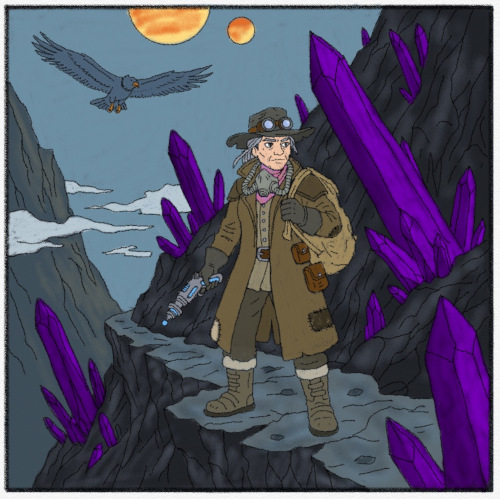
A perilous ascent through Perseverance's mountain ranges, where dark stone hides darker secrets and the air itself becomes an enemy
"You see a cave in those mountains? Best keep moving. Ain't nothing good ever came out of a hole in the ground."
– Old Frontier Saying
Where the Temperate Bands end and the Frozen Expanse begins, the land doesn't fade; it rises. Two great mountain ranges frame Perseverance's polar approaches, one in each hemisphere, like walls built by a planet that wanted to keep its secrets separate.
This is the first of a two-part journey through the heights. In this entry, we'll chart the defining biomes and strange landmarks of the Blackfang Mountains in the Northern Hemisphere and the Shattered Mountains in the Southern, from iron-veined ridgelines and geothermal hellscapes to caverns that hum with something older than settlement. These aren't just obstacles on a map. They're vertical worlds, layered with danger and mystery, where every meter of altitude strips something away: warmth, oxygen.
Two Ranges, Two Hemispheres
Perseverance's mountain ranges mirror each other across the equator – but they are not the same.
In the Northern Hemisphere, the Blackfang Mountains form a jagged barrier of dark, iron-veined stone: mineral-rich and hungry for the unprepared. Their foothills drain into the Silver Creek and the High River network, feeding the northern Temperate Band's trade routes. Beyond their peaks, the ice begins.
In the Southern Hemisphere, the Shattered Mountains rise from the badlands south of the Great Rift Lakes, broken by ancient tectonic violence into a maze of fractured ridges, collapsed calderas, and cavern systems that extend kilometers underground. When the spring snowmelt pours off their slopes, it floods the Rift Lakes and reshapes the southern river basins. What hides in their depths reshapes everything else.
Together, the ranges are Perseverance's last barrier, the line between the settled world and the frozen silence beyond. Few cross willingly. Those who do come back changed, or don't come back at all.
The mountains are not empty. They are watched, by Storm Wraiths circling the high thermals, by rebel scouts glassing the passes, by automated systems buried so deep they've outlived every name the surface has given them. This is a land of thin air and long falls. It rewards caution and punishes everything else.
Major Biomes of the Mountain Ranges
The Mountain Ranges are not a single environment. They're a layered world, where altitude changes everything. The foothills smell like dust and juniper. Higher up, wind-scoured rock and clinging ice. At the peaks, silence and the things that fly. Every hundred meters of elevation strips something away.
"You don't climb the mountains. You negotiate with them. And they always win."
– Lena Holt, Mountain Guide
The Blackfang Ridgeline
The Blackfang Mountains form a wall of dark, iron-veined stone across the Northern Hemisphere's polar approach, earning their name from the jagged peaks that bite the sky like broken teeth. The rock here is dense with ferromagnetic ore and crystalline deposits that make scanning unreliable and mining dangerous.
The Blackfangs are rich. Everyone knows it. The problem is getting it out. The mountains fight extraction with rockslides and a geology that rearranges itself after every seismic event. Commonwealth survey drones last about six hours before signal loss swallows them. Manned expeditions do better – but not by much.
Independent prospectors work the lower slopes, hauling small loads down to the Silver Creek drainage and trading at Virey's Claim. The deeper veins remain untapped, locked behind unstable shafts and toxic gas pockets, not to mention the persistent rumor that something in the Blackfangs doesn't want to be found.
"The ore's there. I've seen it – black crystal veins thick as your arm, humming when you touch them. Problem is, the mountain saw me back."
– Doss Merrik, Independent Prospector (missing, presumed dead)
The Shattered Peaks
The Shattered Mountains are what happens when a planet tries to tear itself apart and almost succeeds. The southern range is a chaos of fractured ridges and deep cavern systems carved by ancient volcanic activity. Peaks lean at impossible angles. Passes open and close with the seasons as ice and rockfall reshape the terrain.
Beneath the surface, the Shattered Mountains are hollow – riddled with lava tubes and cavern networks that extend kilometers underground. Some of these systems are natural. Some are not. The xenoarchaeologists believe the deepest chambers predate human arrival by millions of years, and the crystalline structures found there – geometric, responsive, and faintly warm – are not geological formations at all.
The Commonwealth officially classifies the Shattered Mountains as "unstable terrain, restricted access." In practice, it's where everyone the Commonwealth doesn't want to find has gone to hide – separatist cells, rogue researchers, corporate black sites, and communities that decided the surface world had nothing left to offer them.
"The Shattered Mountains aren't broken. They're opened. Something cracked them from below, and whatever did it is still down there."
– Dr. Elias Morrow, Xenoarchaeologist
The High Passes
Both ranges are cut by High Passes – narrow corridors of wind-blasted stone that connect the Temperate Bands to the polar approaches. In the north, the Blackfang passes link the Silver Creek settlements to the Frozen Expanse beyond. In the south, the Shattered passes climb from the Great Rift Lakes basin toward the southern ice. They are the only overland routes between the settled heartland and the frozen silence, and they are miserable.
The air thins above two thousand meters. Winds accelerate through the passes like water through a sluice, carrying ice crystals that strip exposed skin in minutes. Temperatures drop well below freezing even in summer. Visibility collapses without warning as fog banks roll in from the geothermal vents below.
Despite this, the passes are traveled – by traders hauling goods to polar settlements, by smugglers avoiding Commonwealth checkpoints, by Icebound Covenant missionaries heading south, and by the desperate, the exiled, and the lost. Cairn markers line the routes, maintained by no one in particular and trusted by everyone. Remove a cairn and the mountains will take someone's life. That's not superstition. It's math.
"Three rules for the passes: travel light, travel fast, and don't look down. A fourth? Don't trust the weather. It's lying."
– Kess Halloran, High Pass Courier
The Ash Vents
Along the inner flanks of the Shattered Mountains, where tectonic fractures run deepest, lies a band of geothermal instability known as the Ash Vents. Here, volcanic activity hasn't died. It's simmering. Fumaroles belch sulfurous steam. Hot springs pool in stone basins stained yellow and orange. The ground is warm underfoot and occasionally lethal.
The Vents are both resource and hazard. Geothermal energy is abundant – anyone with the engineering skill to tap it has near-unlimited power. But the geology is treacherous. Ground that was solid yesterday can become a boiling sinkhole tomorrow. Toxic gas pockets collect in hollows, invisible and odorless until your vision blurs and your legs stop working.
A handful of settlements cling to the Vents, powered by the heat beneath their feet and haunted by the knowledge that it could take them at any moment. They are Perseverance at its most honest: survival built on something that might kill you, because the alternative is worse.
"We tap the heat because we need it. The mountain lets us because it hasn't noticed yet." – Sera Voss, Thermal Engineer, Cinderwell
Landmarks of the Heights
The mountains hold places that resist explanation – sites where the stone remembers something the people have forgotten, or where forces older than settlement have left their mark. These landmarks are not destinations. They are warnings and narrative flashpoints for stories that begin with curiosity and end with consequences.
The Crystal Vaults
Cavern system of impossible geometry
Deep beneath the Shattered Mountains, past the last mapped lava tube, lies a network of chambers the xenoarchaeologists call the Crystal Vaults. The walls are lined with crystalline structures – not growing from the rock but embedded in it, as though the stone was poured around them and allowed to cool.
The crystals are warm. They hum at frequencies below human hearing. Some respond to proximity – brightening when approached, dimming when touched. Others display geometric patterns that shift when observed, as though rearranging in response to attention.
Dr. Elias Morrow's team documented three expeditions into the Vaults before the Commonwealth confiscated their data. The fourth expedition never returned. Morrow claims the Vaults are a record: "a library written in light and pressure, by something that thought in shapes we haven't invented yet." The Commonwealth claims the Vaults don't exist.
"I touched the wall and it showed me a city. Not one of ours. The buildings were wrong: too tall, too thin, too many angles. But the sky was Perseverance's sky. I'm sure of that."
– Journal Fragment, Expedition Four (recovered)
The Howling Gate
Pass of acoustic anomaly
At the highest point of the most-traveled pass through the Blackfang Mountains stands a natural stone arch – two pillars of dark basalt leaning together across a gap just wide enough for a loaded skiff. Wind through the arch produces a sound that carries for kilometers: a low, modulated moan that rises and falls with the gusts. Locals call it the Howling Gate, and they don't linger.
The sound is unsettling but explainable: acoustic resonance in a wind corridor. What's less explainable is the effect it has on electronics. Communication equipment stutters. Navigation systems reset. Recorded audio played back near the Gate sometimes contains additional voices – fragments of conversation, in languages that don't match any known settler dialect.
Cairn markers around the Gate are older than any Commonwealth record. Some bear symbols that match those found in the Crystal Vaults. Most travelers pass through quickly, eyes forward, equipment off. A few have tried to study the arch. Their instruments recorded clean data. Their notebooks, however, tell a different story.
"The Gate doesn't scream. It talks. And if you listen long enough, you start to understand – and that's when you run."
– Fenn Osa, Salvage Runner
The Nailbed
Exposed ore field and magnetic graveyard
On the northern slope of the Blackfang range, a massive geological event – earthquake, eruption, or something else, ripped open a square kilometer of mountainside, exposing a field of iron-black crystal spires jutting from the rock at sharp angles. From above, it looks like a bed of nails. From the ground, it looks like a forest of dark glass, some spires taller than a person, humming faintly in the wind.
The Nailbed is intensely magnetic. Compasses are useless. Metal tools stick to the spires. Skiffs that fly too low find their instruments scrambled and their hulls dragged toward the surface. Several wrecks litter the edges of the field – some old, some not.
Prospectors call it the richest exposed ore deposit on the planet. Engineers call it unmineable. The crystals resist cutting and drilling. One independent crew tried explosives. The blast did nothing to the spires but triggered a resonance cascade that shattered every piece of glass and ceramic within a kilometer – including their helmets.
"It's worth a fortune. It's also worth your life. Funny how those numbers always match out here."
– Calla Thrain, Mineral Surveyor
The Watcher's Roost
Storm Wraith nesting colony and no-fly zone
High on the southern face of the Shattered Mountains, where the cliffs drop three thousand meters to the scree fields below, lies the largest known Storm Wraith nesting colony on Perseverance. Hundreds of the massive predatory birds – wingspans exceeding five meters, talons like ship hooks – roost on ledges carved by wind and claw into the vertical rock.
The Roost is a no-fly zone by common sense, not Commonwealth decree. Skiffs that approach within two kilometers trigger territorial responses – coordinated diving attacks from multiple wraiths, fast enough to puncture hull plating. The wreckage of at least a dozen craft lies scattered on the slopes below, some stripped clean by the birds, others untouched and rusting.
On the ground, the Roost is equally dangerous. The approach is a field of loose scree and unstable rock, patrolled by juvenile wraiths too young to fly but old enough to kill. Yet people still come – for feathers (worth a fortune as insulation material), for eggs (rumored to have medicinal properties), or for the view from the southern ledge, which on clear days shows the ice fields of the Frozen Expanse stretching to the horizon.
"A storm wraith don't give warning. One second you're talking, the next, the man next to you is just… gone."
– Lena Holt, Mountain Guide
Conclusion
The Mountain Ranges are more than a barrier between the settled world and the ice. They're a vertical frontier, where the rules of the lowlands dissolve and the planet shows its oldest face. Every ridgeline hides a vein worth killing for. Every cavern holds something that predates every name the surface has given it. And every pass demands a toll – paid in breath, in blood, or in certainty.
These biomes and landmarks define the rhythms of life and death in the heights. They determine who goes up, who comes down, and what changes in between. The Blackfangs guard their wealth behind magnetic storms and crumbling shafts. The Shattered Mountains keep their secrets in caverns that hum with light no one lit. And the passes between – cold, thin, and merciless – are the threads that connect Perseverance's settled heart to whatever lies beyond the ice.
In the next part, we step inside the communities that cling to these slopes – from vertical mining towns and geothermal gambles to separatist strongholds and hidden research camps. We'll also face the dangers that make the mountains lethal: Storm Wraith territory, thin air, unstable ground, and the things buried beneath it all.
Up here, the air thins, and nothing survives without purpose.