
Drawing the Line in the Dust – Genre, Credibility, and Tone in Perseverance
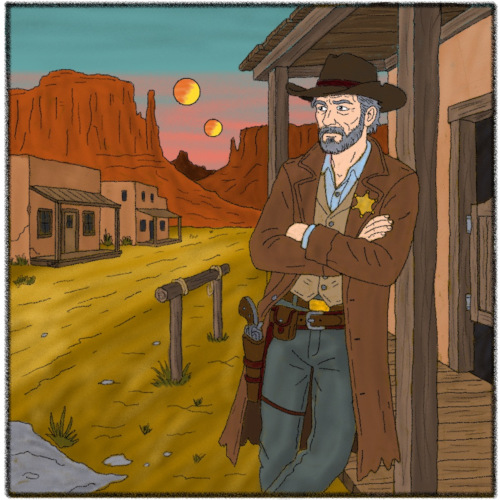
One of the trickiest parts of designing a genre pack isn't the setting or the keywords. It's answering a deceptively simple question: what kind of stories does this game tell?
Not in the abstract, but at the table, in the moment when a player says, "I leap off the canyon wall onto the moving skiff below," and everyone looks at the GM.
Is that credible? In Firefly, absolutely. In No Country for Old Men, probably not. In Perseverance? That depends on the story your group has agreed to tell.
This post is about how I've been thinking about genre and tone for the Perseverance genre pack, and how QuestWorlds gives us elegant tools to handle both.
"You can survive a lot on Perseverance. You just can't survive everything." – Ranger Tessa Dorne
The Credibility Test: QuestWorlds' Quiet Genius
One of the things I love most about QuestWorlds is the credibility test. It's not a rule, exactly. It's more of a shared understanding: does this feel like something that could happen in the kind of story we're telling?
The Core Rulebook puts it simply: if there's a dispute about whether something is credible, the GM should discuss it with the group. Not decree. Discuss. That one word carries a lot of weight.
In Perseverance, I've found credibility draws from three sources:
The genre itself. Westerns have their own logic. A one-against-many standoff where grit and nerve win the day? Absolutely credible. A belt buckle stopping a bullet? Western credible. Teleporting out of danger? Wrong genre.
The table's agreed tone. Some groups will play Perseverance as hardscrabble survival fiction where every wound matters. Others will lean into pulp adventure where bold plans and steady nerves carry the day. Both are valid, but they draw the credibility line in very different places.
The character's established abilities. A prospector's kid who grew up in the Blackfang passes can plausibly free-climb a sheer cliff face. A Commonwealth bureaucrat fresh off the shuttle can't. QuestWorlds already handles this through the stretch mechanic, and it maps perfectly onto Perseverance.
The beauty of this approach is that credibility isn't physics. It's tone. And tone is something the group owns together.
Where Does Your Table Land?
While designing the Rules & Tone chapter, I realized I needed to name the different registers Perseverance can play in. Not to restrict anyone, but to give tables a shared vocabulary for the conversation they should be having before Session One.
I ended up with three:
Hardscrabble. The world is unforgiving. Injuries linger, supplies run low, and even small victories cost something. This is the register for intimate drama, survival stories, and moral ambiguity. The kind of tale where a single bullet changes everything.
Frontier Pulp. The world is dangerous, but competent people can rise to the occasion. Characters take hits and keep moving. This is the default register for most Perseverance play — episodic adventure, heist stories, ensemble action. The kind of tale where a crew pulls off something reckless and barely walks away.
Mythic Western. Characters are larger than life. Reputations precede them. The land itself seems to react to the drama. This is still grounded (no superpowers) but the world bends toward the iconic. The kind of tale where people remember your name.
Most groups I've seen drift between Frontier Pulp and one of the other two, depending on the episode. A tense survival arc might play Hardscrabble for three sessions, then shift to Mythic Western for the climactic showdown. That's fine. What matters is that everyone knows where the dial sits right now, so credibility calls feel consistent within a session.
The Stretch: Rewarding Specificity
QuestWorlds has a mechanic called a stretch that I think deserves more love. When a player proposes an action that isn't quite credible but isn't impossible, the GM applies a –5 or –10 penalty to reflect how far the ability is being... well, stretched.
For the genre pack, I built a quick reference table showing how this plays out in Perseverance:
| Action | Ability | Stretch? |
|---|---|---|
| A smuggler fast-talks a checkpoint guard | Charming Rogue | No, that's what the ability is for |
| A smuggler fast-talks a judge at a tribunal | Charming Rogue | Mild stretch (–5), different arena, same skill |
| A smuggler repairs a skiff engine mid-flight | Charming Rogue | Hard stretch (–10) or denied, charm doesn't fix machines |
This does something important: it rewards specificity. Characters who invest in focused abilities shine in their domain. Generalists trade peak performance for breadth. The frontier values both, but it doesn't pretend they're the same.
One thing I'm careful about in the genre pack: stretch penalties should never punish creative narration. If a player says "I kick dust in his eyes before I draw," that's flavor, not a stretch. Stretches apply when the type of action fundamentally doesn't match the type of ability.
What's Credible on Perseverance?
Part of the genre pack's job is drawing lines — not rigid ones, but useful starting points that a group can adjust. Here's the quick reference I've been working on:
Always credible: Surviving a fistfight with consequences. Tracking someone across open terrain with the right skills. Intimidating locals with reputation alone. Jury-rigging broken gear with scavenged parts.
Credible with context: Surviving a multi-story fall (needs soft terrain). Outrunning an ironhorn on foot (needs a head start). Hacking a Commonwealth system (needs training). Piloting a skiff through a canyon during a storm (needs a damn good pilot).
Stretch territory: Shrugging off a serious wound without treatment. Navigating by stars through a magnetic storm. Convincing a sworn enemy to switch sides mid-fight.
Not credible (in standard Perseverance): Dodging bullets at close range. Falling from orbit and surviving. Mind-reading or telekinesis (unless using the Adapted framework; see the Incredible Powers post). Single-handedly defeating a dozen armed opponents in open combat.
These tiers are guidelines, not scripture. A group playing Mythic Western might push some "stretch territory" items into "credible with context." A Hardscrabble group might tighten the screws even further. The point is to have a shared map of the terrain before disagreements happen at the table.
The Cost of Victory
I want to highlight one QuestWorlds mechanic that I think defines Perseverance at the table: zero-degree outcomes.
Due to the dice math, QuestWorlds contests trend toward zero-degree results, and this is by design. A zero-degree victory means you got what you wanted, but it cost you something. A zero-degree defeat means you lost, but something else opened up.
This is the engine that drives frontier stories.
Victory at a Price: You held the bridge, but your skiff took engine damage. You won the argument, but your ally saw a side of you they didn't like. You caught the fugitive, but the real threat slipped away while you were busy.
Defeat with a Boon: You lost the fight, but your opponent revealed their plan. You failed to convince the council, but one member approached you quietly afterward. You didn't save the cargo, but you saved the crew.
In Perseverance, consequences linger as penalties (–5 to –20) until they're resolved through play. A ranger with a –10 "Bullet wound, left shoulder" isn't just weaker on paper. She's making choices every scene: push through the pain and risk making it worse, or find help and lose time.
That's Perseverance at its best. The frontier doesn't hand out clean victories. And the system backs that up.
Setting the Table
The genre pack includes a short "Setting the Table" section — five questions I'd recommend every group answer before their first session:
- Where's the tone? Hardscrabble, frontier pulp, or mythic western?
- How lethal is it? Does a single gunshot kill, or does it take a dramatic beatdown?
- How much tech? Is alien salvage common, or rare and dangerous?
- What's off the table? Any topics or scenarios the group wants to avoid?
- Who are you to each other? Found family? Uneasy alliance? Professional crew?
You don't need written answers. Just ten minutes of conversation so the credibility test has solid ground to stand on.
"Rules don't keep the peace out here. Agreements do. Same goes for your table." – Sheriff Dale Foster, Rust Creek
What's Next
This post covers the genre and credibility framework, the foundation of the Rules & Tone chapter. Next up: Incredible Powers, which defines the optional supernatural framework for the Adapted, Echo Caves, and precursor relics. If credibility is where you draw the line, Incredible Powers is about what happens when the setting deliberately crosses it.
Stay tuned.